

Many people who use AI every day carry a quiet unease. A student wonders if she could still write the essay on her own. A manager notices that he opens the chatbot before he has spent a minute on the problem. A parent hears that AI is making people lazy and looks again at the homework on the kitchen table. The unease is widespread. In a Pew Research Center survey published in September 2025, 53 percent of American adults said AI would worsen people’s ability to think creatively, and 40 percent said it would worsen their ability to make difficult decisions.
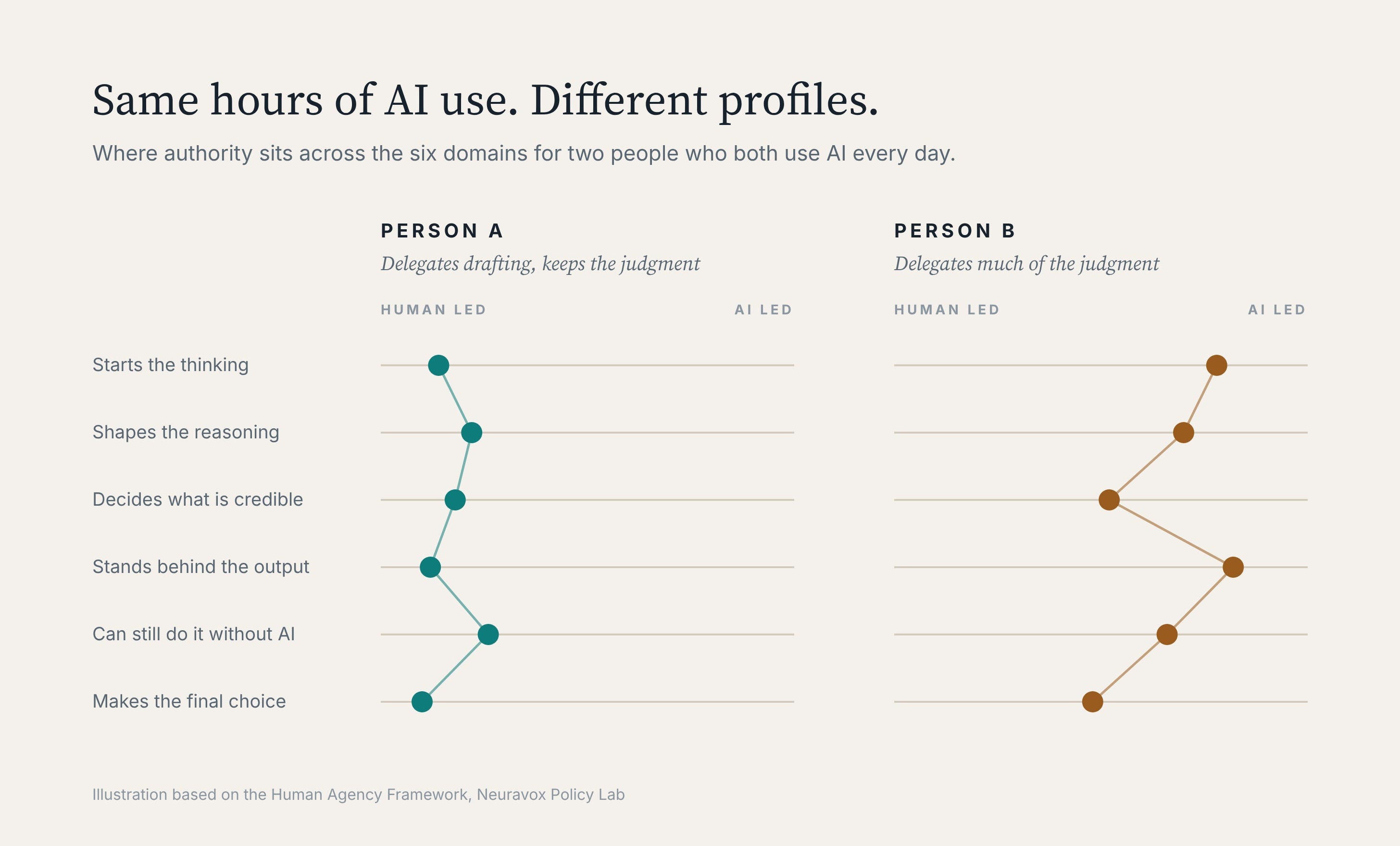
The usual response is to count. Use it less. Set limits. Treat AI the way we learned to treat phones, as something to ration. That advice feels sensible, and it leaves the worry exactly where it was. A person can use AI twice a week and hand over every important judgment. Another can use it all day and stay firmly in charge of the work.
We saw this in our own research. In August, the Neuravox Policy Lab published Human Agency in AI Use, a study based on a survey of 76 adults who had used generative AI for at least three months. How often people used AI told us little about how much control they kept. Most respondents used AI at least daily, and many of them still questioned responses that conflicted with what they knew and could explain their work in their own words. A 2025 study of 319 knowledge workers by researchers at Microsoft and Carnegie Mellon University points the same way. Workers who had more confidence in AI reported less critical thinking. Workers who had more confidence in their own abilities reported more. What mattered was the relationship.
What the worry is about
If hours of use are a poor guide, what is the fear really about? Listen closely and it is about authority. People worry that the machine is starting their thinking for them, steering it, judging it and deciding where it ends. They worry that one day they will need a skill and find it gone.
The Human Agency Framework, which the Policy Lab has now published, turns that fear into six questions. Who starts the thinking? Who shapes the reasoning? Who decides what is credible? Who stands behind the output? What can you still do without AI? Who makes the consequential choice?
Each question names a different part of your agency, and they can move in different directions. You can check every fact an AI gives you and still let it decide how the problem is framed. You can write every word yourself and still borrow a conclusion you never examined. A single score would hide this, so the framework reads the six one at a time.
Handing over work is fine
There is a strand of the AI debate that treats any delegation as a loss. The framework takes a different position. Delegation is why tools exist. Nobody worries that a calculator has stolen their sense of number, because they still decide what to calculate and what the answer means. You can hand an AI the first draft, the literature search or the list of options and keep purpose, judgment and the final call.
The risk lies in a quiet transfer of the parts you never meant to give away. It happens when you accept the AI’s framing of a question because it arrived first and sounded reasonable. It happens when a recommendation becomes the default because choosing against it feels like extra work. At the time, it feels like efficiency.
A good result can hide the problem
This is why the worry so often survives good results. The essay earns a good mark. The report goes out on time. The decision turns out fine. It is tempting to read these outcomes as proof that nothing was lost.
They prove something else. A polished answer can sit on top of weak understanding. A fast decision can rest on a recommendation nobody questioned. The framework keeps outcomes and agency apart for this reason. Speed, quality and confidence are worth measuring, and they tell you how the task went. They do not tell you who did the thinking. Over months, repeated habits of use also shape what people can still do on their own, and that change rarely shows in any single result.
The right amount depends on the task
None of this means every task deserves the same level of human control. Letting an AI summarize routine meeting notes is a reasonable choice. Letting it decide which job applicant gets an interview, or what a patient should be told, is a different matter. The stakes are higher, mistakes are harder to undo, and other people bear the consequences.
The framework describes authority in each domain as human led, shared or AI led, and treats all three as possible. A shared or AI led state can suit a task well. The question is fit. How much is at stake? Can the result be checked? Can it be reversed? Who else is affected? A good relationship with AI is one where the answer to those questions matches where authority sits.
Turning worry into attention
Worry is useful when it turns into attention, and attention works best at specific moments. Before you open the tool, ask what you are trying to do and what should stay yours to decide. While you work, ask if the AI is shaping the task in ways you understand and accept, and what needs checking. When you finish, ask if you could explain the result to someone else, do the core of it without the system, and stand behind the decision.
These questions take a minute. They leave the choice about how much to use AI with you, and they show where your judgment sits. That is the thing most people are afraid of losing.
The Human Agency Framework is free to read and download on the Neuravox Policy Lab page. It includes a quick reflection tool, applied scenarios and an organizational review template for teams. The six domains are working domains, built for practice and further research, and we will revise them as evidence grows. If you try the questions in your own work, teaching or family, we would like to hear what you find.
Read the framework: https://neuravox.org/policy-lab/human-agency-framework